

Nothing kills a workshop's momentum like telling a customer, 'Sorry, we don't have that part in stock.' You lose the job, they lose trust, and your competitor down the road gets the business. For small to medium car workshops in Malaysia, inventory management is often done on scraps of paper or in someone's head. That works until it doesn't. A proper system for tracking parts and setting low-stock alerts can save you money, time, and repeat business.
Many workshop owners think inventory management is only for big dealerships or spare part shops. But even a small workshop with a few hundred parts can benefit. Imagine you have a regular customer who drives a Perodua Myvi. They come in for a brake pad replacement. You check your shelf and see one set left. But it's actually for a different model, or worse, it's already rusted from sitting too long. That scenario plays out every day in workshops across Klang Valley and beyond. Let's fix it.
Why Track Parts at All?
Tracking parts isn't just about knowing what you have. It's about understanding what moves, what sits, and what you should order next. When you track inventory properly, you can:
- Avoid overstocking slow-moving items that tie up cash.
- Ensure fast-moving parts like oil filters, brake pads, and spark plugs are always available.
- Reduce the time spent searching for parts or running to the spare part shop mid-job.
- Improve customer satisfaction by giving accurate wait times and completing jobs faster.
In Malaysia, where many workshops operate on tight margins, every job counts. Losing a job because you didn't have a common part like a Honda City oil filter is avoidable. Simple tracking can prevent that.
Getting Started: What to Track
You don't need to track every single screw and washer. Focus on the parts that directly affect your ability to complete jobs. Here's a practical starting list:
- Consumables: engine oil, transmission fluid, coolant, brake fluid, grease.
- Common replacement parts: brake pads, oil filters, air filters, spark plugs, drive belts.
- Model-specific parts for the cars you see most often (e.g., Perodua Axia, Proton Saga, Toyota Vios).
- High-value items: alternators, starters, compressors, and other parts you might keep for regular customers.
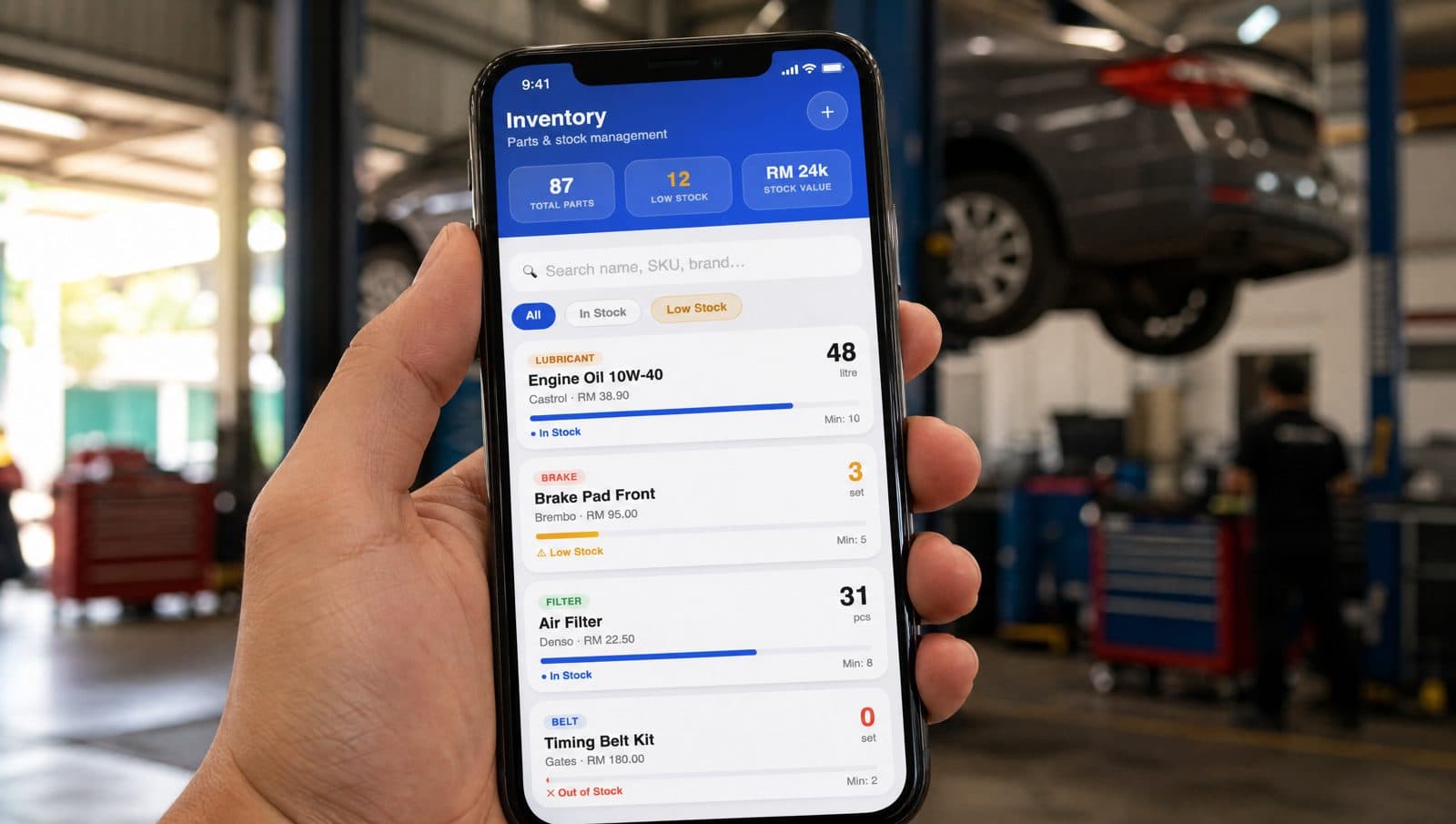
For each part, record the part name, compatible car models, supplier, cost price, selling price, minimum stock level, and current quantity. If you use a digital tool like MekaHub, this information is already structured for you. If you're on paper, a simple ledger or spreadsheet works too, but it takes more discipline.
Setting Low-Stock Alerts
A low-stock alert is a trigger that tells you when a part is running low and needs to be reordered. Without it, you rely on memory or chance. Here's how to set useful thresholds:
- For fast-moving parts (e.g., engine oil for popular cars), set a minimum of 5 to 10 units, depending on your monthly usage.
- For medium-moving parts, set a minimum of 2 to 3 units.
- For slow-moving or high-value parts, set a minimum of 1 unit, and reorder only when you have a confirmed job.
When you receive a low-stock alert, don't panic. Check if you have upcoming jobs that use that part. If yes, order immediately. If not, you have a few days to decide. But never ignore the alert. A common mistake is to think 'I'll remember to order later,' then a customer walks in the next day needing that exact part.
Tip: Review your low-stock levels every three months. As your workshop's job mix changes, so will your part usage. Adjust thresholds accordingly.
How to Avoid Dead Stock
Dead stock is parts that sit on your shelf for months or years and never get used. It's money locked up in dust. Common causes include ordering too many of a part for a specific model that you rarely see, or buying in bulk to get a discount but not having the demand. To minimise dead stock:
- Track the 'last used' date for each part. If a part hasn't been used in 6 months, consider returning it to the supplier or selling it off at cost.
- Order in smaller quantities more frequently. Yes, you might pay a little more per unit, but you reduce the risk of overstocking.
- Use the 80/20 rule: 80% of your jobs likely come from 20% of your parts. Focus on keeping those 20% well-stocked and be lean on the rest.
Another practical tip: when you buy a part for a specific job, don't automatically order an extra 'just in case'. Only order extras for parts you use regularly. For one-off jobs, buy exactly what you need.
Streamlining Stock Takes and Audits
Physical stock counts are necessary but can be painful if done manually. Many workshops only do a stock take once a year, which means discrepancies go unnoticed for months. Instead, aim for a monthly 'quick count' of your top 20 parts, and a full count every quarter. With a digital system, you can do a partial count and compare against your records. MekaHub, for example, lets you update quantities on the go, so your stock levels are always current.
During a stock take, check for damaged or expired parts (yes, brake fluid and oil have shelf lives). Remove them from your active inventory and write them off. This keeps your records accurate and prevents you from selling a bad part.
Linking Inventory to Job Cards and Invoicing
The real power of inventory management comes when it's connected to your job cards and invoices. When a mechanic selects a part on a job card, the system should automatically deduct that part from inventory. This gives you real-time stock levels and prevents double-booking the same part. It also makes invoicing faster because the part price is already recorded. For Malaysian workshops, this integration is especially helpful for SST reporting, since you can easily see which parts were sold and the associated tax.
If you're using MekaHub, this happens automatically. The job card lists the parts used, inventory updates instantly, and the invoice is generated with the correct amounts. No more forgetting to charge for a part or losing track of what was used.
Final Thoughts
Inventory management doesn't have to be complicated. Start small: pick your 10 most-used parts, set minimum stock levels, and commit to updating quantities every time you use or receive them. Once that habit is solid, expand to more items. The goal is to never again tell a customer 'we don't have that part' when it's a part you should have. With a little discipline and the right tools, you can keep your jobs flowing and your customers happy.
Run your workshop from your phone.
Seven days free. No credit card. Set up your first customer, vehicle, and job card in about fifteen minutes.